For SaaS teams of 5 to 15 developers on Slack
Ship 35% more per developer in two months. Right from your Slack.
We install the AI delivery system, run it, and keep improving it. Your team keeps its tools and signs off every change.
Ask for work in Slack, get a reviewed pull request back. Live in week one. Measured on your own Jira or Linear tickets. Start with one seat, cancel anytime.
Found it: the 3‑D Secure redirect drops the card's country, so some EU banks refuse it. One decision before I fix it:
Ready for your review. Fixed, covered by a test, tried on staging, and checked by a fresh reviewer agent that didn't write it.
The scheduling partner's API hit its daily limit at 06:02 and refused 387 completion checks. We don't retry a refused check, so those visits weren't recorded.
79 today, down from 387. A fix that retries refused checks is ready; shipping it to production needs your backend lead's OK:
Working · since 09:12
Reproducing the EU card failure on staging
Helpers: 2 working
Waiting on Anna · poll · since 09:31
“Fix it in checkout only, or in the payments SDK too?”
Working · since 09:33
Writing the fix and its test
Helpers: 2 working
Answered 09:52 · nothing open
Waiting · EU card payments on prod · answered 09:56
Watching: EU card payments on prod · every 1 min · gives up 11:00
Answered 08:20 · nothing open
Waiting on Tom · approval · since 08:24
Deploy the retry fix to production · make deploy-prod
Working · since 08:31
Deploying the retry fix to production
Waiting · every Texas visit recorded · answered 08:38
Next check Sat 07:00
A replay of what BrightGears posts in Slack today: replies, links to cards on the thread page, and one status message it keeps last and edits in place. Names and details changed.
shipped more in September than 10 shipped in February
merged pull requests per developer a month
customer satisfaction with the software, out of 10
Fit
Works best for teams like these.
Not sure you fit? Book 30 minutes. If it's not a match, we'll say so on the call.
Works best when
- You have a dev team shipping a product people pay for
- Delivery is slower than you'd like, and AI feels like it should be helping more
- Your team works in Slack and your code lives on GitHub
- You want results you can measure: we track tickets done per developer before and after
The product
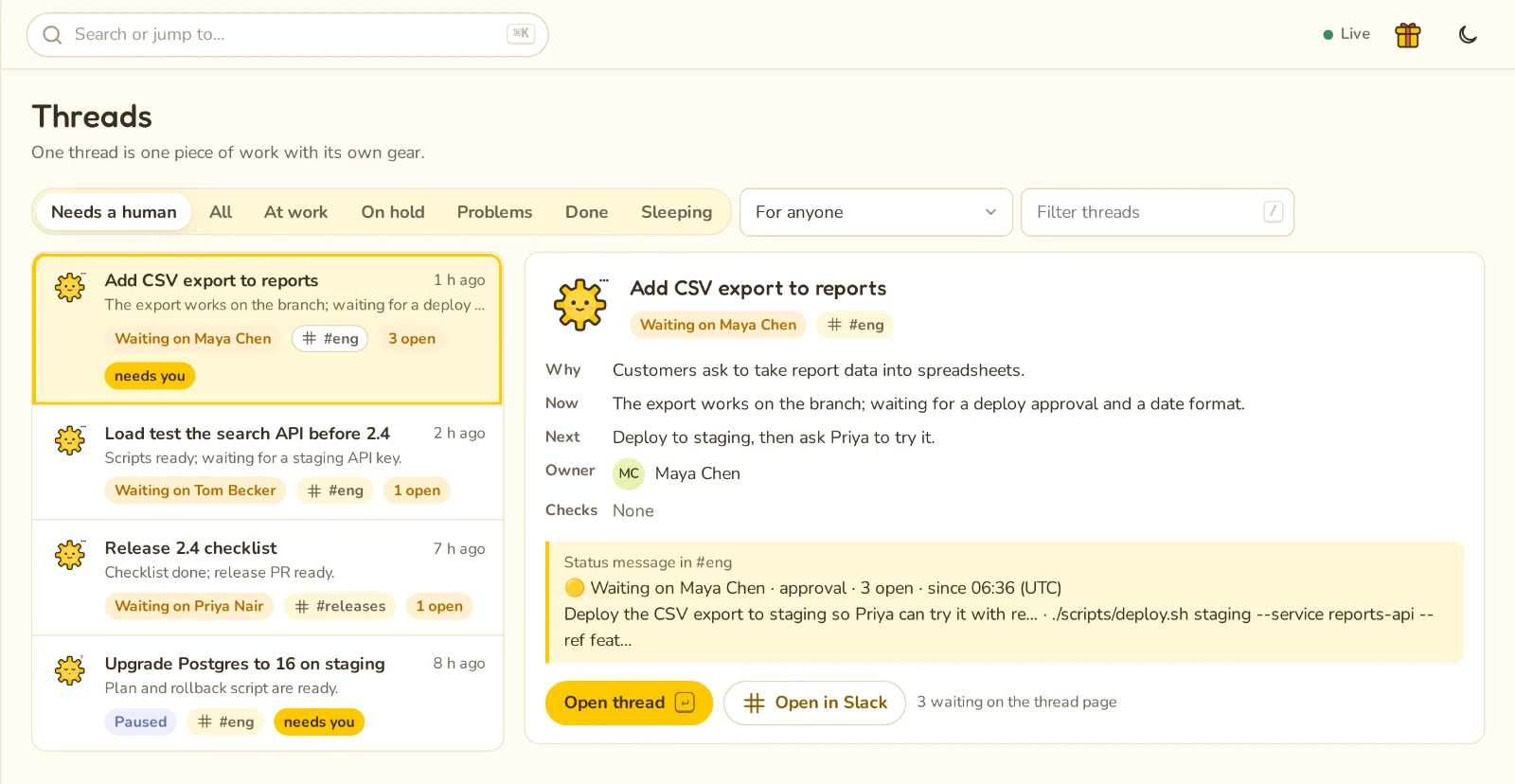
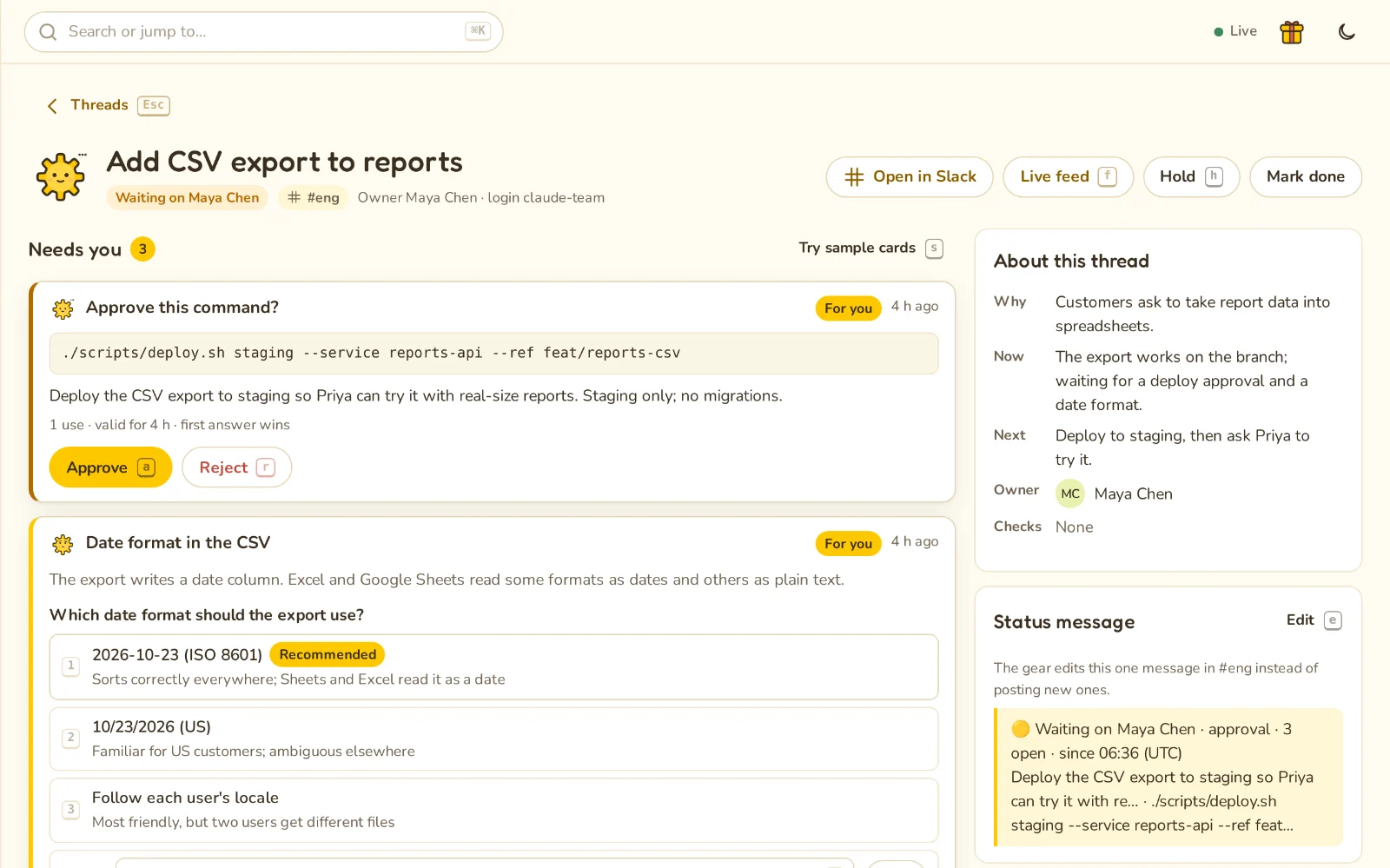
Slack for the work. A web page for what needs a person.
Every thread has a page on your private web UI: what waits on whom, the decisions with one tap, and the full record of what the agent did.
How it works
Install. Run. Keep improving.
Four steps. Two weeks of your team's attention, then none.
-
01Week 1
Align
We sit with your team to understand the product, what it needs next, and where delivery hurts today.
-
02Week 1
Install
We install the factory in your GitHub, CI and Slack, adjust it to how your team works, and ship your first feature through it ourselves.
-
03Week 2
Onboard
Every developer learns to deliver through it. Product, sales and support learn to ask it questions. By the end of week two it's how the team works.
-
04Every month after
Improve
We monitor it, maintain it, and ship improvements every month, for as long as you stay. Without your team's involvement.
The workflowEvery change passes the same eight checkpoints.
Not a coding assistant in Slack. One delivery workflow for the whole team, so you always know what's in progress, what's blocked, and what's waiting on whom.
- Ask in a Slack thread.Describe the change in plain words. One thread, one lead agent, and the context never leaves the thread.
- It clarifies before it builds.Questions when something is unclear. A one-tap card with a recommended answer when a call is yours.
- Plan and ETA, posted first.You see the plan and a rough ETA before any code is written.
- Build and test, by your rules.Your merge style, your test policy, no over-engineering. Every rule you set is remembered and applied to the next change.
- CI green before anything is called ready.A red check never reaches you.
- Independent review by a second model.A different model from a different vendor reviews the diff. Findings are ranked by severity and fixed before you see the change.
- An evidence page on every change.What changed, why, how it was tested, screenshots, the risks.
- Your sign-off, your merge.The system never merges product code. A named human approves, and the thread says "needs you" the moment it does.
Nothing is forgotten: every thread ends with a done line, or stays on the list until it does.
01For your CTO and developers
- Developers steer and review instead of typing.They describe the change; the system plans, builds, tests and gets it reviewed.Senior time goes to judgement, not keystrokes.
- Predictable delivery.Same checkpoints every time, plan and ETA up front, status that reflects reality.You can promise the business a date again.
- Accountability stays human.Nothing reaches production without a named approver and an evidence page.You can answer "why did this ship?" in one link.
02For your CEO, product, sales and support
- Ask the codebase anything, in Slack."Why didn't these visits show up?" Answers in under a minute, with sources.No more pulling a developer off work to explain the product.
- Plain-language recaps in Slack.What shipped, what broke, what waits on whom, posted where your team already looks.You know status without a standup.
- One-tap decisions.When a call needs a human, you get a link in Slack to a card with a recommended answer.You decide; the system does the rest.
Proof
We did it to our own company first.
Sellify is a live B2B SaaS with paying customers, and its delivery runs on this system every day. Same system, same two people who will install yours. February to October 2026:
From our bi-weekly satisfaction survey of Sellify's closest clients. Before: the three months before the factory. After: the three months since it ran the team's delivery.
The team started a proof of concept of the factory in May 2026, tuned it over the summer, and moved all delivery onto it in September. Merged work pull requests, release merges excluded. Your numbers will differ, so we measure your own baseline before day 1.
"Every developer on my team had a Claude or Codex seat for a year, and the speed and reliability still weren't there. What changed it was one workflow for the whole team, with a human signing off every change. We're four developers now, we ship more per person than we ever did with ten, and our closest clients rate the software 9.1 out of 10."
Beyond Sellify
Also running for three more clients. Every improvement BrightGears ships reaches all of them the same month.
How we measure it on your teamPricing
What 35% more is worth to you
For a team of ten, at a senior developer's cost of about $12,000 a month:
Ten developers, $120,000 a month.
Three and a half developers' output, $42,000 a month, no hiring.
Ten seats, $4,990 a month.
Hiring instead: $10,000 to $15,000 a month per senior developer, months to find one, no guarantee. Building it yourself: it takes people who have built agent systems before, then a quarter of a senior developer every month to keep up with the models. Ours took over 100 change requests in its first month.
Our price
Per seat
Ten seats cost less than half of one senior developer.
Every seat includes
- Your own installon your server, in your Slack, GitHub and CI
- The full productgears, status messages, cards, the web UI, habits and routines
- A fresh reviewer on every changeand nothing merges without your sign-off
- Improvements every monthand a direct line to the two founders
How we measure it
Measured on your own tickets, not on a feeling.
We track tickets done per developer before and after, on your own Jira or Linear, and show you the numbers every month.
What we need from you
- Tickets in Jira or Linear
- Access to your repos and CI
- One developer to start
- 30 minutes a week with your lead
Who runs it
Two co-founders. You talk to us directly.
Klim built the factory for Sellify. Ivan ran Sellify's delivery on it and saw output per developer double. Now we install it for teams like yours. No account managers, no outsourced team: a shared Slack channel with both of us in it.


Questions
The questions CTOs ask us
"Do we need Slack?"
Yes. BrightGears lives in your Slack: requests, questions and recaps happen in threads your team already reads, and decisions are one tap away on the web. If you're not on Slack, it's not for you yet.
"Isn't this just Claude in Slack?"
No. Claude Tag gives every company the same hosted agent in Anthropic's cloud, on Anthropic models only. BrightGears is your own multi-agent factory on your server, on the Claude and Codex subscriptions you already pay for, tuned to your team by people who run it with you. Read the full comparison
"My devs already have Claude and ChatGPT."
Seats make individuals faster. We change how the whole team delivers.
"We could build this ourselves."
You could. Then one of your developers maintains it every time the models change, instead of shipping. Running ours took over 100 change requests in its first month.
"I don't want unchecked AI code in production."
Nothing merges without a human sign-off, and every change has an evidence page.
"Our code can't leave our infrastructure."
It runs in your repos, on your own Claude and Codex accounts. We never hold your code or keys.
"What happens to my developers?"
They stop typing and start steering. The system plans, builds and tests; your developers decide, review and sign off. The senior ones get more senior work.
"How do you measure the 35%?"
Tickets done per developer in your Jira or Linear, only tickets with a merged pull request. Against your previous 90 days, per developer per week, with ticket size checked.
"What does my team have to do in the first two weeks?"
One alignment session, access to your repos and CI, at least one developer on a seat, and 30 minutes a week with your lead. We do the rest.
"I'll be locked in."
No minimum. Start with one seat at $499 a month and cancel anytime.
"Do we need to change our tools?"
No. Your GitHub, your CI, your Jira or Linear, your Slack. We plug into what your team already uses.
Book a fit call
Ship 35% more per developer. Start with one seat.
A 30-minute fit call. Bring your Jira or Linear numbers and a Slack workspace. We tell you straight if it's a fit.